
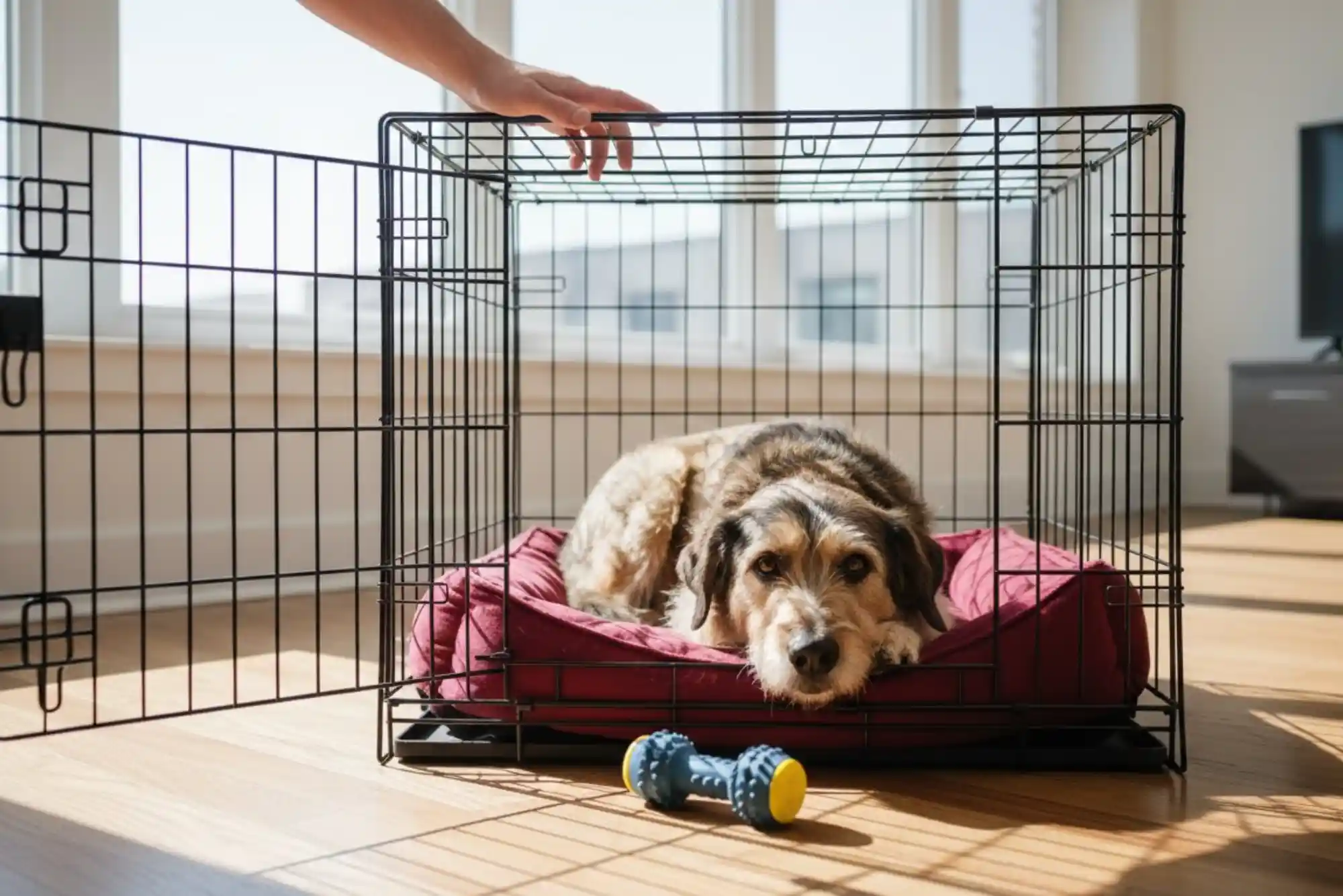
Introduction
Crate training an older rescue dog with separation fears and phobias requires patience, consistency, and a clear understanding of canine behavior. Unlike a confident puppy, an adult rescue dog may arrive with an unknown history, frightening past experiences, or anxiety about being left alone. A crate that seems comfortable to one dog may feel like confinement to another.
The goal is not simply to teach your dog to stay inside a crate. It is to help them associate that space with safety, comfort, and positive experiences. When introduced correctly, crate training can provide a quiet retreat while supporting a dog’s confidence and independence. However, it is not a cure for separation anxiety, and some dogs may feel safer resting in an open bed or another secure area.
With the right approach, you can make meaningful progress without forcing your dog to face fears before they are ready. Understanding their triggers, recognizing signs of distress, and adjusting the training pace are essential to long-term success.
Why Crate Training an Older Rescue Dog Requires a Different Approach
Older rescue dogs often have established habits and emotional responses shaped by their previous environments. Some may have lived comfortably indoors, while others may have spent long periods outdoors, experienced neglect, or associated confinement with punishment.
These experiences can influence how a dog responds to a crate. Closing the door too early, leaving the room immediately, or ignoring signs of distress can make the crate seem threatening rather than reassuring.
Understanding Separation Anxiety and Fear
Separation anxiety occurs when a dog experiences significant distress during separation from an attachment figure. Common signs include persistent barking, whining, pacing, destructive behavior near exits, excessive drooling, and attempts to escape.

Other dogs experience isolation distress, meaning they struggle when left alone even if they are not specifically attached to one person. These conditions can look similar but may require different management strategies.
Crate training an older rescue dog should therefore begin with understanding what causes the distress. A dog who relaxes when someone remains nearby but panics when the door closes needs a different plan from one who becomes frightened by unfamiliar sounds.
Recognizing Phobias and Environmental Triggers
Phobias are intense fear responses to particular situations or stimuli. Thunderstorms, fireworks, traffic noise, unfamiliar people, and sudden household sounds can all trigger fear in sensitive dogs.
A dog with noise phobia may initially enter a crate comfortably but panic when thunder begins. Another dog may associate a particular room with frightening experiences.
Observe your dog’s body language carefully. Trembling, panting when it is not hot, flattened ears, tucked tails, repeated lip licking, hiding, and refusing normally appealing treats can indicate discomfort. These signals should guide your training decisions.
How to Prepare for Crate Training an Older Rescue Dog
Preparation makes the training process more predictable and helps prevent avoidable setbacks. Before purchasing equipment or beginning formal exercises, assess your dog’s needs and the environment where they will spend time.
Choose the Right Crate
The crate should allow your dog to stand naturally, turn around comfortably, lie down, and stretch out. A crate that is too small may be uncomfortable, while an oversized crate is not necessarily a problem for an adult dog if it remains safe and appropriately arranged.
Wire crates offer ventilation and visibility, while plastic airline-style crates provide more enclosed surroundings. Some dogs prefer an open, airy design, whereas others feel more secure with reduced visual stimulation.
Avoid choosing a crate solely because it looks attractive or fits your room. Your dog’s comfort and safety should determine the design.
Create a Calm and Comfortable Space
Place the crate in a quiet area where your dog can rest without feeling isolated from the household. A familiar room may be more reassuring than a distant utility room.
Add comfortable, washable bedding if your dog does not chew or swallow fabric. You can also place a familiar blanket inside, provided it is safe for your dog.
If your dog has a history of chewing, digging, or attempting to escape, supervise carefully before introducing bedding or other items that could create a hazard. Never use equipment that could trap your dog’s head or limbs.
Rule Out Medical Problems
Pain, digestive discomfort, age-related changes, and other medical issues can increase anxiety or make confinement uncomfortable. Older dogs may also experience hearing or vision changes that affect their reactions to unfamiliar environments.
Arrange a veterinary examination if your dog shows sudden behavioral changes, severe anxiety, or unusual distress. A veterinarian can help identify medical contributors and determine whether behavioral treatment or medication may be appropriate.
Step-by-Step Guide to Crate Training an Older Rescue Dog
The most effective approach uses gradual exposure and positive reinforcement. Each stage should be based on your dog’s comfort rather than a fixed timetable.
Let Your Dog Explore the Crate Freely
Begin by placing the crate in the chosen location with the door secured open. Allow your dog to investigate without being pulled, pushed, or carried inside.
You can sit nearby, speak gently, or continue a quiet activity while your dog explores. If they approach the entrance, reward them with a small treat or calm praise.
Some dogs will investigate immediately, while others may need several days to approach. Avoid placing food so far inside that a frightened dog feels pressured to enter.
The purpose of this stage is to make the crate a familiar object rather than a source of uncertainty.
Build Positive Associations With Food and Rewards
Once your dog approaches the crate comfortably, begin rewarding voluntary interactions. Offer treats near the entrance, then gradually place them just inside as confidence increases.
You can also provide meals beside the crate before moving the food bowl closer to the entrance. If your dog remains relaxed, the bowl can gradually move farther inside.
Never withhold meals to force a fearful dog into the crate. If your dog stops eating or backs away, reduce the difficulty and return to an easier step.
Crate training an older rescue dog works best when the dog discovers that approaching the crate predicts pleasant experiences and that they can move away when they need to.
Encourage Voluntary Entry
When your dog willingly enters the crate to retrieve treats, reward them for stepping inside without being lured into an uncomfortable situation.
You can introduce a cue such as “crate” or “bed” once the behavior begins to develop naturally. Say the cue calmly as your dog enters, then reward them while they remain inside.
Initially, allow them to leave whenever they choose. Repeated voluntary entries help establish confidence before you introduce any restrictions.
If your dog enters only to grab a treat and immediately retreats, that is still progress. Do not rush toward longer stays before the dog feels comfortable entering fully.
Introduce Brief Door Movement
Closing the crate door is often the most sensitive stage for a dog with confinement fears. Begin only when your dog can remain inside with a relaxed body and willingly return after leaving.
Move the door slightly, reward your dog, and reopen it. Repeat until this small movement no longer causes concern.
Next, close the door for a second or two while remaining beside the crate. Reward calm behavior and open the door before your dog becomes distressed.
Increase the duration gradually, changing only one aspect at a time. If your dog starts panting, scratching, whining intensely, or trying to escape, stop and return to an easier step.
Do not leave a frightened dog to cry until they give up. This can increase fear and potentially cause injury during escape attempts.
Practice Short Periods of Calm Rest
Once your dog accepts the closed door comfortably, gradually extend the time spent inside. Begin with a few seconds, then move toward longer intervals as the dog remains relaxed.
Offer a suitable food toy or chew only if you know your dog can use it safely without supervision. Some dogs enjoy these activities, while others will not eat when anxious.
Remain nearby at first. Your dog should be able to rest, breathe normally, and respond to ordinary household activity without becoming increasingly agitated.
If the dog repeatedly gets up, watches the door, or refuses food they normally enjoy, the session may be too difficult. Shorter, easier sessions are usually more productive than prolonged confinement.
Build Distance Gradually
A dog may tolerate a closed crate while you sit beside it but become frightened when you stand up or walk away. Introduce these changes separately.
First, shift your position while staying in the same room. Later, stand briefly, take a step away, or move around a nearby piece of furniture.
Only progress to leaving the room for a moment when your dog remains relaxed during smaller movements. Return calmly, without making arrivals and departures unusually exciting.
Crate training an older rescue dog with separation fears should include practice at different distances, not just longer periods behind a closed door. If your dog panics whenever you leave, stop increasing the distance and consider help from a qualified behavior professional.
Practice Realistic Departures Carefully
Before using the crate during actual absences, rehearse departure cues such as picking up your keys or putting on your shoes without immediately leaving.
If these cues trigger anxiety, practice them at an intensity your dog can tolerate. Eventually, brief departures can be introduced when the dog is comfortable with the earlier stages.
Use a camera to observe what happens after you leave. Some dogs appear calm initially but become distressed several minutes later.
Do not assume your dog is ready for a full workday simply because they manage a short practice session. Progress from seconds to minutes and beyond only when their behavior supports it.
How to Manage Phobias During Crate Training
Fear-related setbacks often occur when an unexpected trigger appears. The objective is to reduce the intensity of these experiences while maintaining the dog’s sense of safety.
Handling Thunderstorms and Fireworks
If your dog fears loud noises, provide access to a quiet interior room and reduce exposure to sudden sounds where possible. Curtains, white noise, or steady background sounds may help soften some environmental noise.
Do not insist that a dog remain crated during a storm if confinement intensifies their panic. A secure room or a familiar hiding place may be a better temporary option.
Pair mild versions of known triggers with pleasant experiences when appropriate, but avoid deliberately exposing a highly frightened dog to intense noise.
Responding to Fear of People or Unfamiliar Places
Some rescue dogs feel vulnerable when strangers approach their resting space. Position the crate away from busy walkways and ask visitors not to reach inside or disturb the dog.
Allow your dog to choose whether to approach unfamiliar people. Reward relaxed observation from a comfortable distance rather than forcing direct interaction.
A crate should function as a protected resting area, not a place where the dog is trapped while people attempt to socialize with them.
Avoiding Common Training Mistakes
Rushing the process is one of the most common reasons crate training becomes difficult. Other mistakes include using the crate as punishment, forcing the dog inside, leaving them confined beyond their comfort level, and ignoring signs of panic.
Avoid using the crate as a substitute for exercise, companionship, or treatment for separation-related problems. Dogs need appropriate movement, enrichment, toilet breaks, and opportunities to interact with their environment.
Consistency matters, but consistency does not mean repeating a frightening exercise until the dog stops resisting. It means providing predictable, manageable experiences that gradually build trust.
What to Do If Your Older Rescue Dog Panics in the Crate
If your dog bites the bars, throws their body against the door, drools heavily, or tries desperately to escape, stop treating crate tolerance as the immediate goal.
Escape attempts can lead to broken teeth, damaged nails, and other injuries. If your dog is in immediate danger, prioritize safe release rather than preserving the training exercise.
Return to a less restrictive environment and consult your veterinarian. A veterinary behaviorist or appropriately qualified, reward-based behavior professional can help assess the severity of the problem.
For some dogs, treatment may involve a structured behavior modification plan, changes to the home environment, and medication prescribed by a veterinarian. Medication is not a failure; it can sometimes help a dog learn when anxiety otherwise prevents progress.
An exercise pen, dog-proofed room, or secure gated area may be more suitable than a closed crate. The best management choice is the one that keeps the dog safe while minimizing distress.
How Long Does It Take to Crate Train an Older Rescue Dog?
There is no universal timeline. A confident dog may learn to enter and rest in a crate within days, while a fearful rescue may need weeks or months of gradual practice.
The dog’s previous experiences, anxiety level, health, environment, and ability to recover after stressful events all influence progress.
Measure success through behavior rather than the calendar. Relaxed body language, voluntary entry, normal eating, comfortable resting, and the ability to remain calm during small movements are more meaningful indicators than simply staying behind a closed door.
If progress stalls, reduce the difficulty instead of repeating the same exercise more intensely. Small, consistent improvements often lead to more durable results.
Build Trust Before Expecting Independence
Crate training an older rescue dog with separation fears and phobias is ultimately an exercise in building trust. The crate should become a place where your dog feels secure, not a space they learn to endure through exhaustion or fear.
Start with voluntary exploration, reward calm behavior, introduce the door gradually, and increase distance only when your dog is comfortable. Pay attention to signs of stress and remain flexible when a particular method is not working.
Remember that not every dog will benefit from closed-crate confinement. A safe room or another comfortable resting area can be a better solution, especially when separation anxiety is severe.
Ready to help your rescue dog feel more secure? Begin with a short, positive session today and let your dog’s comfort guide the next step. If panic or separation distress continues, contact your veterinarian or a qualified behavior professional to develop a plan tailored to your dog’s needs.
FAQs
Can you crate train an older rescue dog?
Yes, many older rescue dogs can learn to enjoy a crate when it is introduced gradually and positively. Start by allowing voluntary exploration, reward calm interactions, and avoid forcing the dog inside. Dogs with a history of confinement trauma may need additional support or an alternative resting space.
Should I crate my dog if they have separation anxiety?
Not necessarily. A crate may help a dog who already feels comfortable inside, but it can worsen distress in dogs who panic when confined. Monitor your dog’s behavior during short practice sessions and consult a veterinarian if separation-related symptoms are significant.
How do I stop my rescue dog from crying in the crate at night?
First, determine whether the crying reflects fear, a toilet need, discomfort, or difficulty settling. Keep the crate near a familiar sleeping area if that helps, reward calm behavior, and make sure the dog has had appropriate opportunities to relieve themselves. Do not ignore escalating panic or assume every vocalization is attention-seeking.
What is the 3-3-3 rule for rescue dogs?
The 3-3-3 rule is a popular guideline suggesting that a newly adopted dog may need roughly three days to decompress, three weeks to begin settling into a routine, and three months to build a stronger sense of belonging. These are informal estimates, not scientific deadlines. Individual dogs adjust at different rates, and fearful dogs may need considerably longer.
Is it better to leave a crate door open or closed?
An open door is generally best during the early introduction stage because it allows the dog to explore freely. Closing the door should come later, after the dog willingly enters and remains relaxed. For dogs who panic when confined, leaving the door open or using another safe resting area may be more appropriate.
How long can an older rescue dog stay in a crate?
The appropriate duration depends on the dog’s health, toilet needs, mobility, temperament, and comfort with confinement. Avoid prolonged periods that prevent adequate movement, social interaction, or bathroom breaks. A dog with separation anxiety should not be left crated for extended periods simply to encourage them to become accustomed to being alone.
What should I do if my rescue dog tries to escape the crate?
Treat frantic escape attempts as a sign of serious distress and a potential safety risk. Arrange a safe alternative to confinement, avoid repeating the same stressful setup, and seek veterinary guidance. A behavior professional can help determine whether gradual crate training, a different environment, or additional treatment is appropriate.